Business Context
TELUS, Canada’s leader in connectivity, needed a website to establish itself as a the government partner of choice for infrastructure projects that bring high-speed internet to remote areas across the country.
The company works in alignment with the government’s goal to connect every community in Canada by 2030, strengthening the path of reconciliation. Internet access creates opportunities for economic growth, education, and healthcare.
The challenge was to support government trust and provide a clear digital presence by organizing and connecting content from multiple sources into a streamlined website.
The company works in alignment with the government’s goal to connect every community in Canada by 2030, strengthening the path of reconciliation. Internet access creates opportunities for economic growth, education, and healthcare.
The challenge was to support government trust and provide a clear digital presence by organizing and connecting content from multiple sources into a streamlined website.
UX Serving Business Needs
The initiative involves hundreds of rural and Indigenous communities, dozens of partnerships, and significant public and private investment. Progress and impact are represented across many different stories and sources, from government announcements to corporate updates and community-driven narratives.
The project brought together multiple streams of content from the TELUS News (Media Hub), the TELUS Blog (Social Impact), federal and provincial government announcements, and YouTube videos from TELUS channel. My role as the designer was to integrate these diverse elements into a clear and cohesive digital presence that positioned TELUS as a trusted government partner in rural connectivity.

Designing Structure with Purpose
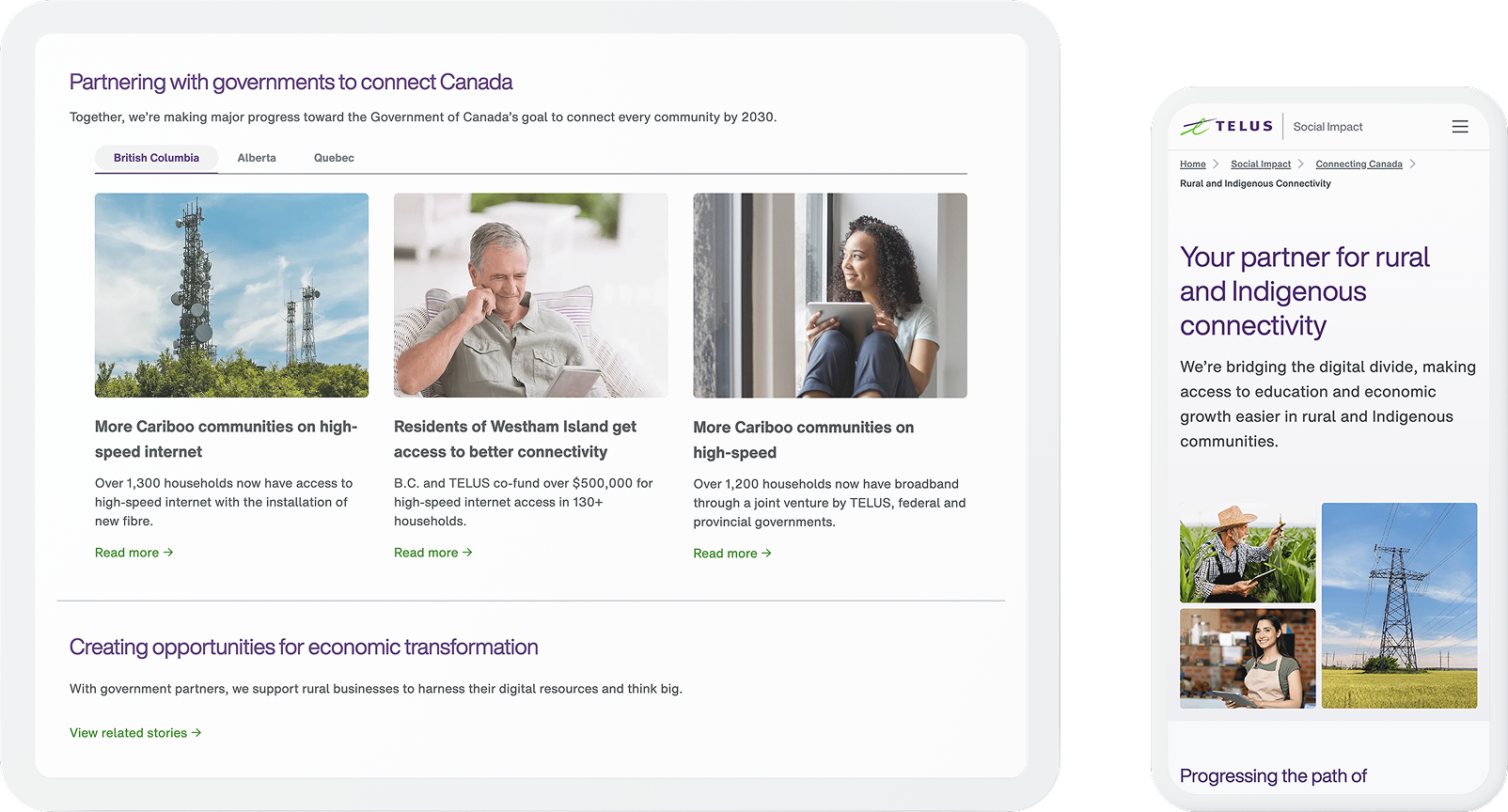
I worked on the content strategy to transform different narratives into a structured experience with a clear purpose. Each section was designed to carry meaning: impact metrics to establish TELUS’ leadership, social outcome stories to show how connectivity improves education, healthcare, and community life, and provincial government news to highlight partnerships and credibility.
On the wireframe side, I defined hierarchy, character counts, and image use to make sure information felt clear, balanced, and fluid. This process brought together a wide range of content types in one consistent framework that guided stakeholders and laid the foundation for visual design.
On the wireframe side, I defined hierarchy, character counts, and image use to make sure information felt clear, balanced, and fluid. This process brought together a wide range of content types in one consistent framework that guided stakeholders and laid the foundation for visual design.

Visual Design Aligned with Brand
With the structure defined, I designed the page using the TELUS design system, applying brand typography, colour, and spacing to ensure consistency and accessibility across all screen sizes. Layouts highlighted impact metrics alongside authentic community stories.
I selected and treated imagery according to TELUS photography standards to unify tone, and exported compressed files to improve performance. The final design balanced visual clarity with brand fidelity and was reviewed by the TELUS Digital Review Board to validate accessibility, performance, and quality.
I selected and treated imagery according to TELUS photography standards to unify tone, and exported compressed files to improve performance. The final design balanced visual clarity with brand fidelity and was reviewed by the TELUS Digital Review Board to validate accessibility, performance, and quality.
Results and Outcomes
The Rural and Indigenous Connectivity page became a strategic tool for TELUS to demonstrate progress and build trust with government partners. By presenting stories, partnerships, and impact in one clear experience, the page positioned TELUS as the partner of choice for future infrastructure projects.
From a digital perspective, the page gained strong visibility in search engines, becoming a leading reference for rural and Indigenous connectivity in Canada. It was also supported by TELUS’ broader communications, including a dedicated YouTube series on reconciliation and connectivity and cross-links from other TELUS pages, reinforcing its role as the central digital reference for this initiative.
From a digital perspective, the page gained strong visibility in search engines, becoming a leading reference for rural and Indigenous connectivity in Canada. It was also supported by TELUS’ broader communications, including a dedicated YouTube series on reconciliation and connectivity and cross-links from other TELUS pages, reinforcing its role as the central digital reference for this initiative.
For me as a designer, this project reinforced the importance of connecting UX strategy and visual design directly to business objectives. It showed how clarity and accessibility in design can amplify both corporate credibility and community impact.